Painting Smokey and the Bandit: Getting Past the Ugly Stage
Nov 09, 2026
I wanted to do this painting just for fun. Sheriff Buford T. Justice and the Bandit. Jackie Gleason and Burt Reynolds looking at each other across the painting.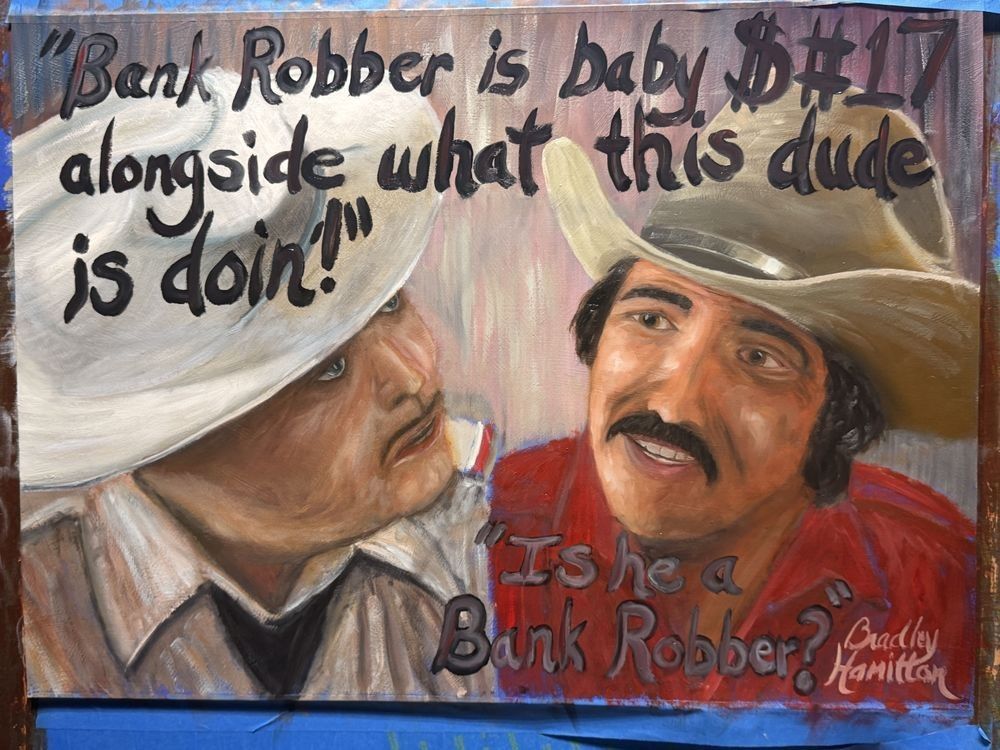
The idea came from the diner scene in Smokey and the Bandit. The sheriff comes in wanting a Diablo sandwich while the Bandit is sitting at the counter. Their interaction gave me something I wanted to paint. And my brother is a big fan of the movie, which made it even better.
But getting the idea onto the canvas took some time.
Getting Through the Ugly Stage
I put down the first paint and got a rough image established. The figures were there, but the painting was nowhere near finished.
That rough first part can be difficult to get through. It is for me. You look at what you have and wonder how you're going to get it where you want it.
I call it the ugly stage.
This painting stayed there for quite a while. I let it sit. Then I finally decided I needed to get it done. So I sat down, got the paint out, and put it on the palette.
I added a little linseed oil to make the paint move more smoothly. Then I mixed the colors I wanted before going back into the faces.
Burt Reynolds Didn't Look Like Burt Reynolds
His face needed work. I could see a face, but I wasn't seeing Burt Reynolds yet.
And that's a funny thing when you're painting someone recognizable. You can have the features in place and still not have the person.
I worked on the larger areas first. The dark areas, then the light areas. I kept adjusting his face before getting into the eyes and smaller touch-ups.
Watching the likeness change was pretty funny. A few adjustments would help, and then something else would need attention.
It took more than getting one feature right. I needed the whole face to work together.
I Still Know It's an Eye
People say when you're painting an eye, don't think of it as an eye. Think of it as another shape.
I try to do that, but I know it's still an eye.
Some painters turn the painting upside down to help them see the shapes. I understand the idea. But when I'm working on a face, I still know what I'm looking at.
There are all these little areas asking for attention. The surrounding shadows, the shape of the eyelids, and the small highlights where light catches the eye.
For this painting, I left those smaller adjustments until after the larger areas were working. Otherwise, I could spend all my time on an eye while the rest of the face still needed help.
Was I Going to Ruin It With Writing?
Once I had the faces where I wanted them, I had another decision to make.
I wanted writing on the painting. Something like the call-outs in a comic, showing the conversation between the two characters.
I'd never done it before.
The painting had turned out well, and I didn't want to ruin it. But the conversation was part of why I wanted to paint the scene in the first place.
So I went ahead and did it.
It worked out okay. I think it could be better. Looking at it now, I probably made the call-outs too big. If I did it again, I'd make them smaller.
That's something I can carry into the next painting.
Painting Something Because You Want To
I told my brother I was giving him the painting for Christmas. He thought it was pretty cool, and he's happy with it.
I'm happy I finished it.
Sometimes you want to paint something because you enjoy it. You don't need to make every decision fit somebody else's idea of what a painting should be.
A commission brings another person's expectations into the work. You need to understand what they're asking for. But it doesn't mean your creativity disappears. They're hiring you for your skills, and your own touches can be part of what they appreciate.
This one started with a movie scene I enjoyed. It sat unfinished. I questioned the faces and the writing. Then I worked through it and finished something my brother will enjoy.
If you're looking at an unfinished painting right now, look at the larger areas before chasing every little detail. Where does the face need adjusting? Are the dark and light areas working? Pick something you can work on and begin there. You don't have to figure out the entire painting before you sit down.
If you'd like to see more of what I paint, explore my artwork at Hamilton Paintings.
Written by Bradley Hamilton
Bradley Hamilton is a professional oil painter and U.S. Army veteran based in Monterey County, California. His work includes realism, palette knife painting, and mixed media abstract realism. He also creates products for artists through Halico Art, LLC. His latest product is Artist Saver™. Explore his paintings at Hamilton Paintings and learn more about Artist Saver™.